> ## Documentation Index
> Fetch the complete documentation index at: https://docs.inflection.io/llms.txt
> Use this file to discover all available pages before exploring further.
# Manage and Troubleshoot Data Warehouse Syncs
> Monitor, pause, change, and fix your data warehouse import and export connections after setup.
Once a data warehouse connection is live, this page is where you go to check on it, change it, or work out why data looks wrong. It covers both import connections, which read from your warehouse, and export connections, which write Inflection events into it. Where the two behave differently, the section says so.
Setting up a new connection is covered in [Import from Data Warehouse](/connections/import-from-data-warehouse) and [Export to Data Warehouse](/connections/export-to-data-warehouse).
## Connection States
| State | Meaning |
| - | - |
| **Draft** | An import connection that is still being set up. Resume it from the Connections list, or delete it. |
| **Active** | Validated and activated. Syncs run on the schedule. |
| **Paused** | Syncs are stopped. Data already brought in stays. Resume to return to Active. |
| **Inactive** | An export connection that has been created but not yet validated and activated by Inflection. |
Pausing only stops new syncs. It never removes data that has already been synced.
## Open a Connection
Click **Connections** in the left navigation, then **Data Connections**. The list shows every connection with its state. The **Active only** toggle is off by default so drafts and paused connections stay visible. Turn it on to see only active connections.
If a connection you just created is missing from the list, check that **Active only** is off.
Click a connection to open it. The connection page has three tabs: **Sync**, **Connection Details**, and **Change Log**.
* **Sync** shows the next scheduled sync, the duration of the last completed sync, the number of records synced, the tables updated, and a sync history table with one row per run: timestamp, target table, rows inserted or updated, and error count. Filter the history by date range or to hide empty syncs.
* **Connection Details** shows the credentials and database details. Secrets are stored securely and never displayed. For Snowflake connections this tab also holds the **Storage Setup SQL** and, for exports, the **Table Creation SQL**.
For import connections, the **Sync frequency** stat shows the connection schedule. When an object overrides it, the stat reads, for example, **Daily by default** with one line per overriding object.
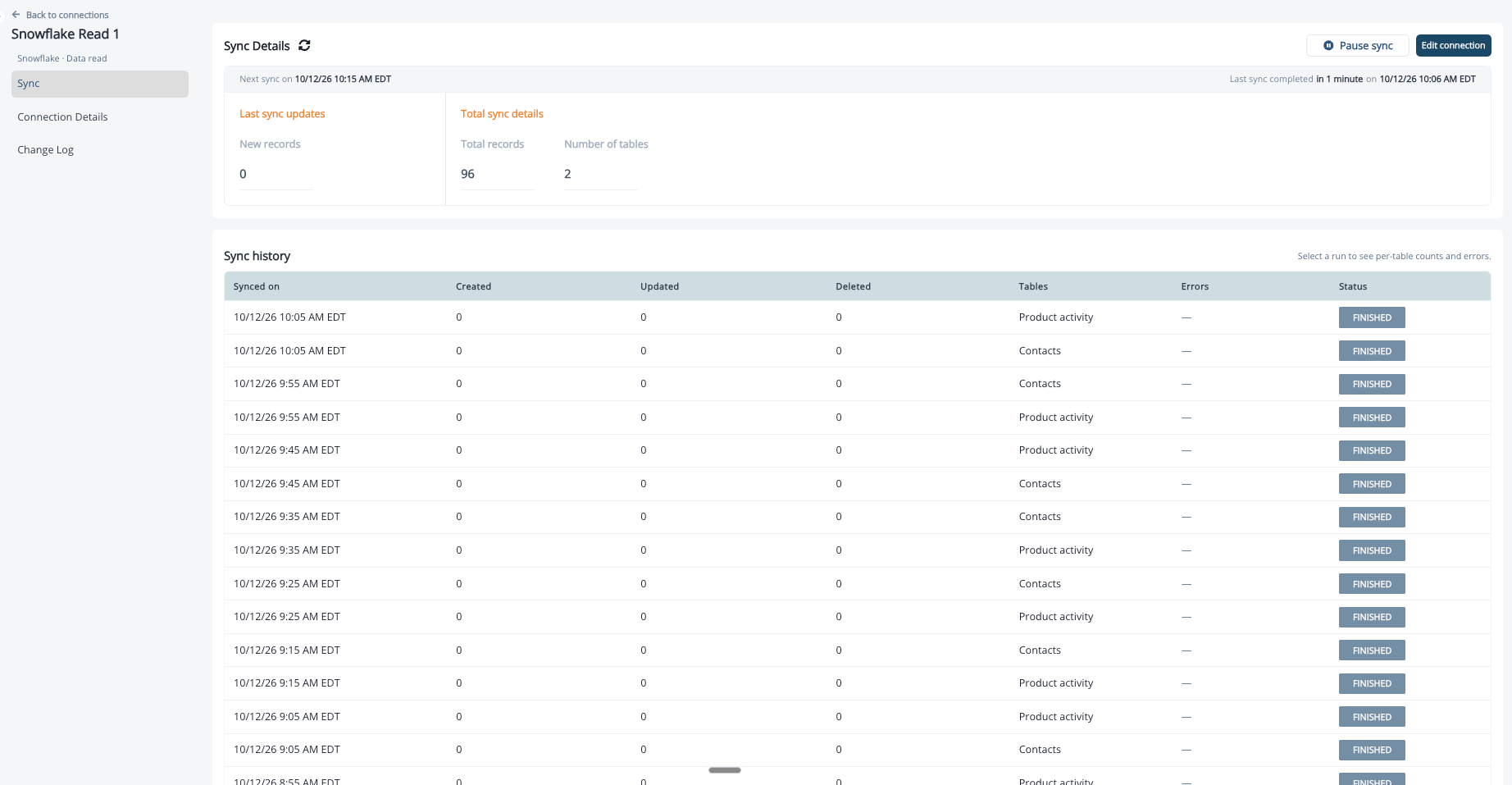 ## Pause and Resume
Click **Pause Sync** in the top right of the connection page to stop new syncs. Click it again to resume. Data already synced is untouched either way.
A connection can also pause on its own. The common causes:
* **A source agreement was broken.** On an import connection that reads a table as it is, a mapped column was renamed or dropped, or the ID or modified date stopped meeting its rule. The error names the column. Fix the source, or update the mapping, then resume.
* **Credentials expired or were rotated.** Update them under **Connection Details**, then resume.
* **Repeated sync failures.** Check the sync history for the error, then resume once the cause is fixed.
If a sync paused and none of these apply, contact your Inflection team. A pause should always have a cause you can see.
## Change Credentials and Settings
1. Open the connection and click **Connection Details**.
2. Click **Edit Details**. The sync pauses while you edit.
3. Update the fields and save. For an import connection you can re-enter secrets without redoing setup, then test the connection again.
To move a Snowflake connection from a password to key-pair authentication, follow [Switch from Password to Key-Pair Authentication](/connections/warehouses/snowflake#switch-from-password-to-key-pair-authentication) on the Snowflake Setup page. The steps are the same for import and export connections.
## Change the Sync Schedule
**Import connections** are self-serve. Open the connection, edit the schedule, and choose a **Frequency**: **Every 10 minutes**, **Every 30 minutes**, **Hourly**, **Every 4 hours**, **Every 12 hours**, or **Daily**. For **Every 12 hours** and **Daily** you also set a **Time of day** and time zone. Shorter frequencies run on a cycle from activation. Each object can follow the connection schedule or override it.
Pick a frequency that matches how often your source tables actually update. A table refreshed nightly gains nothing from a 10-minute sync. Suppression or trigger logic that depends on recent activity may justify a shorter interval.
**Export connections** are scheduled at activation. To change the interval, contact your Inflection team with the interval you want and why. Intervals between 24 and 72 hours keep export volumes manageable on Redshift and Snowflake.
## Delete a Connection
Delete a connection from the connection page. A draft can be deleted at any time. An active connection can be deleted only when none of its columns are still mapped to a field in Unified Mapping. If any are, the delete is blocked and the mapped fields are listed. Remove this connection as a source from those fields in [Unified Mapping](/connections/unified-mapping), then delete.
To stop syncing a single object without deleting the connection, remove that object instead. See [Remove an Object from a Connection](#remove-an-object-from-a-connection).
## Remove an Object from a Connection
You can remove one object, such as Accounts or Product activity, and keep the rest of the connection running.
1. Open the connection and go to **Set up your data**.
2. Select the object in the left rail.
3. Click **Remove from connection**, then click **Remove** to confirm.
Inflection stops syncing the object and drops its mapping. The tables in your warehouse are not touched, and you can set the object up again later.
The **Remove from connection** button appears only for an object whose setup has been saved. If any of the object's fields are still mapped to a field in [Unified Mapping](/connections/unified-mapping), the removal is blocked and the mapped fields are listed. Remove the connection as a source from those fields in Unified Mapping, then remove the object.
## Change Your Source Tables Safely
Inflection expects a stable schema on the tables it reads.
* **Adding columns is safe.** New columns appear as unmapped sources in [Unified Mapping](/connections/unified-mapping) and change nothing until you map them.
* **Renaming or dropping a mapped column pauses the sync.** The error names the column. Before you rename or remove a column that Inflection reads, remove its mapping in Unified Mapping first, or coordinate with your Inflection team.
* **Sequence larger changes.** If you are adding new columns while retiring old ones, add the new columns first, confirm they sync, and drop the old ones as a separate later step.
* **A full resync follows a schema fix.** Once the table is repaired, Inflection resyncs it in full. Timing depends on volume and is typically within a day. Avoid structural changes right before a time-sensitive send.
Renaming, retyping, or removing an attribute on the Inflection side happens in Unified Mapping, not in the connection. Changing a mapping there does not resync the connection.
If you built a view on top of your tables, a breaking change to an underlying table, such as dropping a column, breaks the view and therefore the connection.
## How Inflection Handles Duplicates and Deletes
**Contacts are identified by email.** Keep one row per email address in your source. If the same email appears on several rows, they should carry the same data. When a table is read as it is, the most recently updated row wins. When Inflection drafted a view for you, the deduplication rule you approved decides. An email wrapped in JSON is treated as invalid, and Inflection may resolve the contact from a different, less complete row.
**Product activity is append-only.** Events are never deleted by the sync, even if the rows disappear from your warehouse.
**Deleted rows.** On Snowflake and Amazon Redshift, Inflection keeps an ID-only snapshot in the write location and compares it with the source on each sync to detect rows that disappeared. On BigQuery and Databricks there is no snapshot, so removing a row from your table does not remove the record from Inflection. Where deletes are not detected, add an `is_deleted` flag column to your table instead of deleting rows, sync it as an attribute, and use it as an exclusion filter in journeys and audiences.
**Switching the key to email.** If a sync is keyed on a hashed or generated ID and records are deleted and recreated on every run, which can blank fields set by forms or webhooks, keying the sync on email stops the churn. This requires one stable row per email in the source and a full resync. Talk to your Inflection team before making the change.
## Sync Timing
* A change in your warehouse shows in Inflection after the **next scheduled sync**, not instantly. Before assuming something is broken, compare when the last sync completed with when the source changed.
* Inflection syncs incrementally using the **modified date** or **event timestamp** you confirmed during setup. Rows whose timestamp falls outside the window since the last sync are not picked up. Add a column that records the real insert or update time, such as `updated_at`, so late-arriving rows are caught.
* **Organizations and product users must land before their activity.** If an activity event arrives before the matching user or organization exists, it has nothing to attach to and looks missing until the user record catches up. Keep the user, organization, and activity tables syncing on aligned intervals, and do not let user data lag behind activity.
* After activation, the schedule takes up to five minutes to register. During that window the page may show **Next sync paused** and a manual first sync may not start. Wait and try again.
## Before a Large Backfill
If you are about to load a large amount of historical data into a synced table, such as all-time organization attributes, tell your Inflection team the timing first. An unannounced backfill can congest the sync for your connection.
## Troubleshooting
The most common cause is a key mismatch between tables. The product user ID on your activity or membership table does not match the ID on your Product users table, or the organization ID does not match your Organizations table. Column swaps in view logic are a frequent culprit.
Check it in your warehouse:
```sql theme={null}
-- Users referenced by activity that do not exist in the users table
SELECT COUNT(*)
FROM .product_activity a
LEFT JOIN .product_users u ON u.id = a.product_user_id
WHERE u.id IS NULL;
-- Membership rows whose user does not exist
SELECT COUNT(*)
FROM .product_user_organization m
LEFT JOIN .product_users u ON u.id = m.user_id
WHERE u.id IS NULL;
```
If the counts are large, fix the join key in your source or view. Also confirm which column actually holds the organization ID on your users table. If many users legitimately have no organization, a blank organization field on those records is expected.
Check, in order: when the last sync completed relative to the change; whether the row's modified date or event timestamp was updated when the row changed; whether the timestamp column carries the time zone you declared; and whether the connection is paused. If the row is from a batch job that ran late or crossed midnight, an audit column with the real write time is what lets Inflection catch it.
First narrow what you sync. A separate contacts table alongside your product users is often unnecessary and can complicate the sync, because Inflection creates contacts from product users automatically. If narrowing the scope does not clear it, contact your Inflection team with the connection name and the time it stalled.
Open the connection and read the latest error in the sync history. A broken source agreement names the column. Expired credentials say so. Fix the cause and click **Pause Sync** again to resume. If there is no visible cause, contact your Inflection team; a pause should always have a trigger you can see.
A column Inflection reads was renamed or dropped. Either restore the column name in the warehouse, or remove the field's mapping in Unified Mapping and, if needed, map the new column. The sync resumes with a full resync of that table.
The export tables in your warehouse do not match the shape Inflection writes. Compare them with the **Table Creation SQL** under **Connection Details** and add the missing columns, or drop and recreate the tables from the script. See [Export to Data Warehouse](/connections/export-to-data-warehouse) for the expected columns.
The column named is the one that stopped meeting its source agreement: it was renamed, dropped, or its values no longer satisfy the rule, for example a null ID. Check the column in your source table first, then the view if you built one, then the mapping in Unified Mapping.
This documentation is built and hosted on [Mintlify](https://mintlify.com), a developer documentation platform.
## Pause and Resume
Click **Pause Sync** in the top right of the connection page to stop new syncs. Click it again to resume. Data already synced is untouched either way.
A connection can also pause on its own. The common causes:
* **A source agreement was broken.** On an import connection that reads a table as it is, a mapped column was renamed or dropped, or the ID or modified date stopped meeting its rule. The error names the column. Fix the source, or update the mapping, then resume.
* **Credentials expired or were rotated.** Update them under **Connection Details**, then resume.
* **Repeated sync failures.** Check the sync history for the error, then resume once the cause is fixed.
If a sync paused and none of these apply, contact your Inflection team. A pause should always have a cause you can see.
## Change Credentials and Settings
1. Open the connection and click **Connection Details**.
2. Click **Edit Details**. The sync pauses while you edit.
3. Update the fields and save. For an import connection you can re-enter secrets without redoing setup, then test the connection again.
To move a Snowflake connection from a password to key-pair authentication, follow [Switch from Password to Key-Pair Authentication](/connections/warehouses/snowflake#switch-from-password-to-key-pair-authentication) on the Snowflake Setup page. The steps are the same for import and export connections.
## Change the Sync Schedule
**Import connections** are self-serve. Open the connection, edit the schedule, and choose a **Frequency**: **Every 10 minutes**, **Every 30 minutes**, **Hourly**, **Every 4 hours**, **Every 12 hours**, or **Daily**. For **Every 12 hours** and **Daily** you also set a **Time of day** and time zone. Shorter frequencies run on a cycle from activation. Each object can follow the connection schedule or override it.
Pick a frequency that matches how often your source tables actually update. A table refreshed nightly gains nothing from a 10-minute sync. Suppression or trigger logic that depends on recent activity may justify a shorter interval.
**Export connections** are scheduled at activation. To change the interval, contact your Inflection team with the interval you want and why. Intervals between 24 and 72 hours keep export volumes manageable on Redshift and Snowflake.
## Delete a Connection
Delete a connection from the connection page. A draft can be deleted at any time. An active connection can be deleted only when none of its columns are still mapped to a field in Unified Mapping. If any are, the delete is blocked and the mapped fields are listed. Remove this connection as a source from those fields in [Unified Mapping](/connections/unified-mapping), then delete.
To stop syncing a single object without deleting the connection, remove that object instead. See [Remove an Object from a Connection](#remove-an-object-from-a-connection).
## Remove an Object from a Connection
You can remove one object, such as Accounts or Product activity, and keep the rest of the connection running.
1. Open the connection and go to **Set up your data**.
2. Select the object in the left rail.
3. Click **Remove from connection**, then click **Remove** to confirm.
Inflection stops syncing the object and drops its mapping. The tables in your warehouse are not touched, and you can set the object up again later.
The **Remove from connection** button appears only for an object whose setup has been saved. If any of the object's fields are still mapped to a field in [Unified Mapping](/connections/unified-mapping), the removal is blocked and the mapped fields are listed. Remove the connection as a source from those fields in Unified Mapping, then remove the object.
## Change Your Source Tables Safely
Inflection expects a stable schema on the tables it reads.
* **Adding columns is safe.** New columns appear as unmapped sources in [Unified Mapping](/connections/unified-mapping) and change nothing until you map them.
* **Renaming or dropping a mapped column pauses the sync.** The error names the column. Before you rename or remove a column that Inflection reads, remove its mapping in Unified Mapping first, or coordinate with your Inflection team.
* **Sequence larger changes.** If you are adding new columns while retiring old ones, add the new columns first, confirm they sync, and drop the old ones as a separate later step.
* **A full resync follows a schema fix.** Once the table is repaired, Inflection resyncs it in full. Timing depends on volume and is typically within a day. Avoid structural changes right before a time-sensitive send.
Renaming, retyping, or removing an attribute on the Inflection side happens in Unified Mapping, not in the connection. Changing a mapping there does not resync the connection.
If you built a view on top of your tables, a breaking change to an underlying table, such as dropping a column, breaks the view and therefore the connection.
## How Inflection Handles Duplicates and Deletes
**Contacts are identified by email.** Keep one row per email address in your source. If the same email appears on several rows, they should carry the same data. When a table is read as it is, the most recently updated row wins. When Inflection drafted a view for you, the deduplication rule you approved decides. An email wrapped in JSON is treated as invalid, and Inflection may resolve the contact from a different, less complete row.
**Product activity is append-only.** Events are never deleted by the sync, even if the rows disappear from your warehouse.
**Deleted rows.** On Snowflake and Amazon Redshift, Inflection keeps an ID-only snapshot in the write location and compares it with the source on each sync to detect rows that disappeared. On BigQuery and Databricks there is no snapshot, so removing a row from your table does not remove the record from Inflection. Where deletes are not detected, add an `is_deleted` flag column to your table instead of deleting rows, sync it as an attribute, and use it as an exclusion filter in journeys and audiences.
**Switching the key to email.** If a sync is keyed on a hashed or generated ID and records are deleted and recreated on every run, which can blank fields set by forms or webhooks, keying the sync on email stops the churn. This requires one stable row per email in the source and a full resync. Talk to your Inflection team before making the change.
## Sync Timing
* A change in your warehouse shows in Inflection after the **next scheduled sync**, not instantly. Before assuming something is broken, compare when the last sync completed with when the source changed.
* Inflection syncs incrementally using the **modified date** or **event timestamp** you confirmed during setup. Rows whose timestamp falls outside the window since the last sync are not picked up. Add a column that records the real insert or update time, such as `updated_at`, so late-arriving rows are caught.
* **Organizations and product users must land before their activity.** If an activity event arrives before the matching user or organization exists, it has nothing to attach to and looks missing until the user record catches up. Keep the user, organization, and activity tables syncing on aligned intervals, and do not let user data lag behind activity.
* After activation, the schedule takes up to five minutes to register. During that window the page may show **Next sync paused** and a manual first sync may not start. Wait and try again.
## Before a Large Backfill
If you are about to load a large amount of historical data into a synced table, such as all-time organization attributes, tell your Inflection team the timing first. An unannounced backfill can congest the sync for your connection.
## Troubleshooting
The most common cause is a key mismatch between tables. The product user ID on your activity or membership table does not match the ID on your Product users table, or the organization ID does not match your Organizations table. Column swaps in view logic are a frequent culprit.
Check it in your warehouse:
```sql theme={null}
-- Users referenced by activity that do not exist in the users table
SELECT COUNT(*)
FROM .product_activity a
LEFT JOIN .product_users u ON u.id = a.product_user_id
WHERE u.id IS NULL;
-- Membership rows whose user does not exist
SELECT COUNT(*)
FROM .product_user_organization m
LEFT JOIN .product_users u ON u.id = m.user_id
WHERE u.id IS NULL;
```
If the counts are large, fix the join key in your source or view. Also confirm which column actually holds the organization ID on your users table. If many users legitimately have no organization, a blank organization field on those records is expected.
Check, in order: when the last sync completed relative to the change; whether the row's modified date or event timestamp was updated when the row changed; whether the timestamp column carries the time zone you declared; and whether the connection is paused. If the row is from a batch job that ran late or crossed midnight, an audit column with the real write time is what lets Inflection catch it.
First narrow what you sync. A separate contacts table alongside your product users is often unnecessary and can complicate the sync, because Inflection creates contacts from product users automatically. If narrowing the scope does not clear it, contact your Inflection team with the connection name and the time it stalled.
Open the connection and read the latest error in the sync history. A broken source agreement names the column. Expired credentials say so. Fix the cause and click **Pause Sync** again to resume. If there is no visible cause, contact your Inflection team; a pause should always have a trigger you can see.
A column Inflection reads was renamed or dropped. Either restore the column name in the warehouse, or remove the field's mapping in Unified Mapping and, if needed, map the new column. The sync resumes with a full resync of that table.
The export tables in your warehouse do not match the shape Inflection writes. Compare them with the **Table Creation SQL** under **Connection Details** and add the missing columns, or drop and recreate the tables from the script. See [Export to Data Warehouse](/connections/export-to-data-warehouse) for the expected columns.
The column named is the one that stopped meeting its source agreement: it was renamed, dropped, or its values no longer satisfy the rule, for example a null ID. Check the column in your source table first, then the view if you built one, then the mapping in Unified Mapping.
This documentation is built and hosted on [Mintlify](https://mintlify.com), a developer documentation platform.